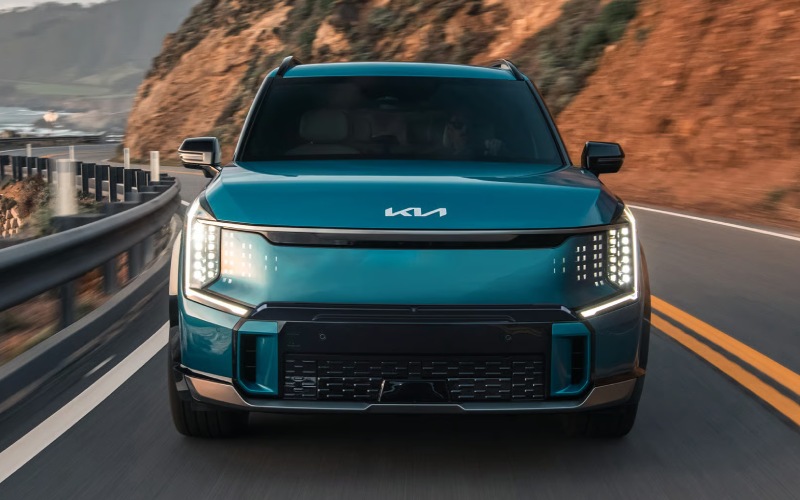
Mission Viejo Kia - Which three-row electric SUV charges faster for real-world trips around Irvine, CA — 2026 Kia EV9 or 2026 Rivian R1S?
When shoppers compare the 2026 Kia EV9 and the 2026 Rivian R1S, the most common question we hear is simple: which one charges faster in the real world? For families mapping daily commutes, school runs, and weekend getaways around Irvine, CA, charge times are more than numbers on a spec sheet — they dictate whether your stop is a quick coffee break or a longer layover. Let’s break down how each SUV approaches fast charging and why the EV9’s 800-volt class platform is such a meaningful advantage.
Charging Architecture: Why voltage matters
The 2026 Kia EV9 is built on an advanced 800-volt class platform. In practical terms, that architecture allows the EV9 to accept very high charge power with efficient heat management and minimal time loss shifting between charge steps. On a 350 kW DC fast charger, the EV9 can go from 10-80% in as little as 24 minutes. That short window is a difference-maker when you’re connecting a few errand stops into a busy Saturday or topping up before heading to the Toll Roads for a dinner reservation.
The 2026 Rivian R1S features a powerful 400-volt class system with high peak charge acceptance. It’s quick for its class, and with larger available battery packs, the R1S can stretch range substantially. However, in like-for-like conditions on comparable high-power chargers, the R1S typically takes longer to move from a low state-of-charge to the 80% sweet spot. This isn’t a knock on the R1S — it’s a reflection of how higher-voltage EV architectures, like the EV9’s, keep charge times especially tight.
Real-world speed: What affects your stop length
On paper, the EV9’s 10-80% in as little as 24 minutes looks unbeatable for a three-row SUV. In the real world, several variables still influence your session: charger health, ambient temperature, preconditioning, starting battery temperature after freeway driving, and even your wheel-and-tire setup. Kia helps with smart thermal management and available route-based preconditioning, so the battery is better prepared to take on high power when you arrive. The result? More consistent sessions and fewer surprises when the family wants to keep moving.
The R1S also benefits from preconditioning and solid thermal control, but because it operates on a 400-volt class system, its charge curve generally reaches lower peaks than the EV9’s 800-volt class setup on the same station types. That means you’ll usually see a few more minutes per stop in similar starting conditions — something to consider for road trips with tight itineraries or kids who prefer short breaks.
Network access: Where can you plug in fast?
The EV9 includes a built-in North American Charging Standard (NACS) charge port, opening access to more than 18,000 Tesla Superchargers and significantly expanding the pool of DC fast chargers across Southern California. This built-in access reduces the need for adapters and simplifies navigation to high-power stations that fit your route, whether you’re heading south along the 5 or across the 405 to the beach.
The Rivian R1S also offers access to the Tesla Supercharger network for compatible vehicles and locations. It’s still important to check station details — power levels, stalls available, and whether a given site best suits your route and timing. Both SUVs support DC fast charging broadly, but the EV9’s native NACS hardware streamlines the process with fewer steps before plugging in.
Range vs. charge time: What matters more day to day?
Range is a key part of the conversation. Certain R1S configurations can post very high EPA-estimated ranges, which is appealing for long highway stretches. On the EV9 side, Kia-estimated ranges up to 305 miles cover a full day’s driving for most families with buffer to spare. The question is not just “how far can I go on one charge?” but also “how quickly can I add meaningful range when I need it?” If your day includes back-to-back commitments, the EV9’s shorter 10-80% window can save time — and reduce stress — without requiring you to arrive at a charger nearly empty.
Home charging and daily routines
For most owners, home charging handles the bulk of energy needs. With a professionally installed Level 2 charger (often 40-48 amps), overnight replenishment keeps both SUVs ready for the next day. Kia’s Qmerit partnership can simplify getting a home charger installed, and features like Kia Connect help you schedule charging for off-peak hours. Either way, the fastest charging you’ll do is usually while you sleep — daytime DC fast charging is there to keep your week on track when plans change or you need an extra afternoon top-off.
How this plays out around town
A quick example: you’re at a kids’ game near the Great Park, then planning dinner with friends across town. You’ve got 20% to start and time for a short stop. Plug the EV9 into a 350 kW station: in the time it takes to grab a snack and stretch, you can be back at 80%, with range headroom to spare. With an R1S on a comparable station, you’ll likely spend longer at the charger to reach that same 80% target. Over months of similar stops, the EV9’s consistent, shorter sessions add up to a smoother rhythm.
Frequently Asked Questions:
Does the EV9 or R1S get more benefit from a 350 kW DC fast charger?
The EV9’s 800-volt class platform is designed to take greater advantage of very high-powered chargers, enabling a 10-80% session in as little as 24 minutes. The R1S benefits from high-power stations too, but typically not to the same time-saving extent.
Will either SUV slow down fast charging in cold or very hot weather?
Yes — extreme temperatures can affect both vehicles. Preconditioning helps by bringing the battery closer to its optimal temperature before you arrive, which the EV9 supports via route planning and thermal management. It’s a good practice in either SUV for consistent results.
What about Supercharger access if I take regular trips across Southern California?
The EV9’s built-in NACS port gives you direct access to many Tesla Superchargers. The R1S also offers access at compatible sites. Always check power levels, stalls, and real-time availability in your route planner for the best outcome.
Bottom line: Which charges faster?
Both SUVs can charge quickly, but the EV9’s 800-volt class architecture, native NACS port, and proven 10-80% in as little as 24 minutes on a 350 kW charger make it the more time-efficient choice for most busy families. When a day goes from school to sports to dinner, shaving minutes off your stop keeps plans on schedule and stress levels low.
Mission Viejo Kia is serving Irvine, Lake Forest, and Aliso Viejo with hands-on EV guidance — from choosing the right home charging setup to planning your first road trip with reliable fast-charge stops. If your top priority is minimizing time at the plug while maximizing flexibility, the EV9 is the three-row EV that fits how Southern California really drives.
- Key takeaway: EV9’s 800-volt class platform and native NACS port streamline fast charging for shorter, more predictable stops.
- Planning tip: Precondition the battery en route to a DC fast charger for the best charge curve in either SUV.
- Daily routine: Use home Level 2 charging for the majority of miles, saving DC sessions for schedule-critical top-ups.